
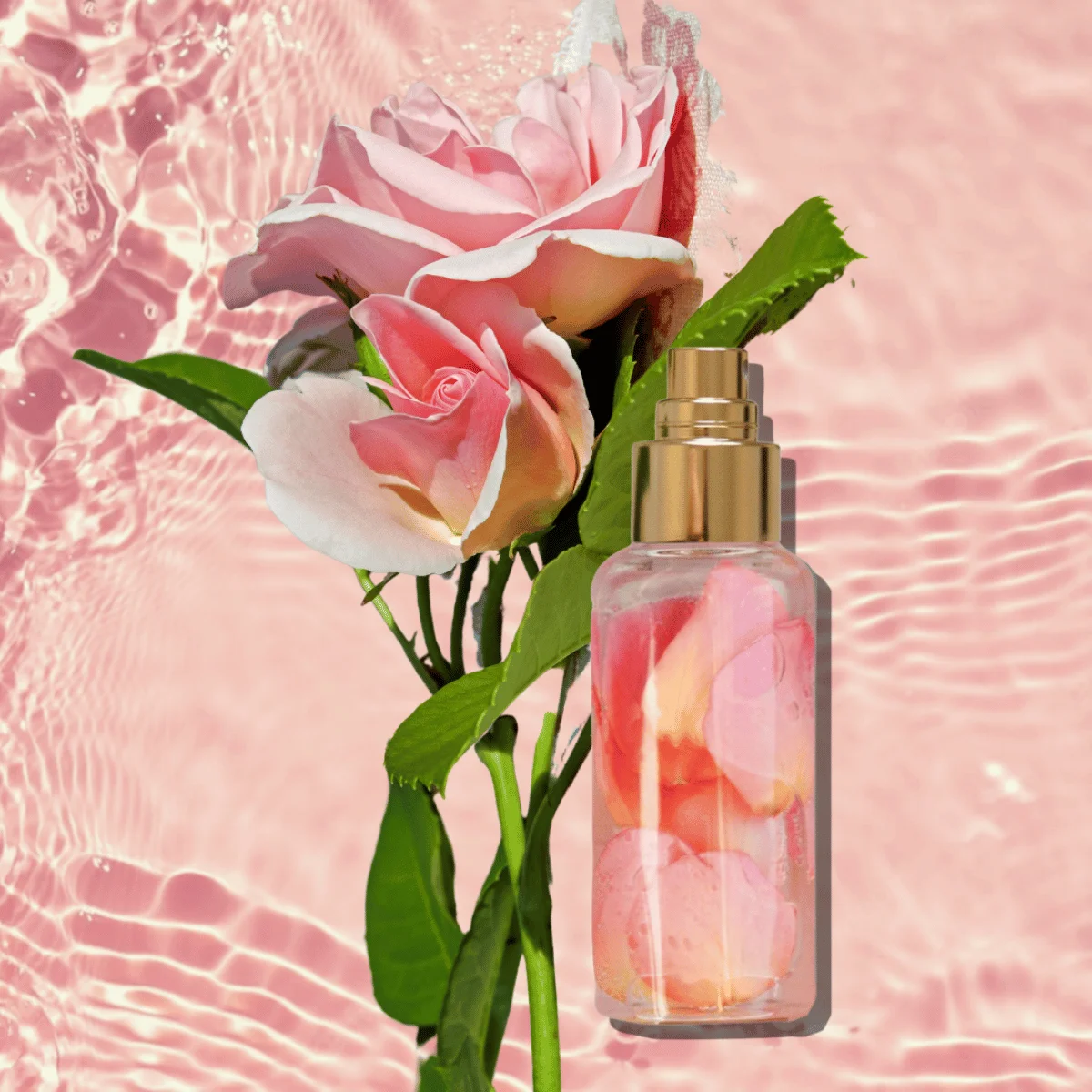
The short answer: simmer organic rose petals in distilled water, strain, bottle, refrigerate. Done in under 45 minutes. But the difference between rose water that genuinely helps dry skin and rose water that just smells nice comes down to three decisions — your rose source, your water quality, and your application method. Get any of those wrong and you’ve made expensive floral tea.
Why Rose Water Actually Works on Dry Skin
Rose water isn’t just water with rose fragrance added. It’s a hydrosol — a water-based extract that captures the water-soluble compounds from rose petals during gentle heating or steam distillation. The main active compounds are phenylethanol, citronellol, geraniol, and flavonoids including quercetin and kaempferol.
These aren’t just nice-sounding chemistry words. Each one does something measurable. Phenylethanol is the primary aromatic compound in Rosa damascena and carries documented antimicrobial properties. Citronellol and geraniol are terpene alcohols shown to reduce pro-inflammatory cytokine activity — the inflammatory signals that degrade your skin barrier over time. Quercetin is one of the most studied antioxidant flavonoids, with consistent evidence for reducing oxidative stress in skin cells.
How It Addresses Dry Skin at the Root Level
Most dry skin isn’t just dehydrated — it’s experiencing some level of barrier dysfunction. The stratum corneum, the outermost skin layer, has gaps or reduced lipid content, which means water evaporates faster than it should. Rose water helps from two angles: its anti-inflammatory compounds reduce the chronic low-grade inflammation that degrades barrier function over time, and it temporarily increases surface hydration when applied.
The word “temporarily” matters. Rose water is humectant-adjacent — it draws moisture toward the skin surface but doesn’t lock it in. This is exactly why sequence matters: apply rose water first, then follow with an occlusive or lipid-rich moisturizer while skin is still damp. For dry skin, products like CeraVe Moisturizing Cream (ceramides and hyaluronic acid, around $16 for 16oz) or La Roche-Posay Toleriane Double Repair Face Moisturizer make ideal follow-ups — they provide the barrier lipids that rose water simply can’t supply.
The pH Benefit Most People Overlook
Healthy skin runs slightly acidic, roughly pH 4.5 to 5.5. Tap water is typically pH 7.0 to 8.0. Every time you wash your face with tap water, you temporarily push your skin’s pH toward alkaline, which disrupts the acid mantle and worsens barrier dysfunction. Quality rose water sits at approximately pH 5.0 naturally. Applying it post-cleanse helps your skin re-establish its acid balance faster. For chronically dry skin, this is not a trivial benefit — it’s a meaningful, measurable one.
What Rose Water Cannot Do
It won’t repair a severely damaged skin barrier on its own. For that, you need ceramides, fatty acids, and cholesterol — the lipids that physically make up the barrier structure. Rose water is a supporting ingredient, not a treatment. Manage expectations accordingly: think of it as a prep step that calms inflammation, lightly hydrates, and makes your moisturizer absorb more effectively. That’s genuinely useful. Just not magical.
What You Need Before You Start
Most failed batches of homemade rose water trace back to sourcing problems, not technique. This is where to focus first.
Choosing the Right Roses
Use Rosa damascena (Damask rose) or Rosa centifolia (cabbage rose) — these varieties carry the highest concentration of beneficial compounds and produce the most aromatic petals. Both are widely available as organic dried petals from reputable herbal suppliers.
Do not use florist roses. Full stop. Commercial cut flowers are treated with pesticides, fungicides, preservatives, and sometimes dyes throughout their growing and transport cycle. These residues don’t fully break down during a 20-minute simmer. Applying pesticide-laced water to already-compromised dry skin is counterproductive at best, actively irritating at worst.
Mountain Rose Herbs sells certified organic Rosa damascena petals for around $8–12 per ounce dried — enough for three or four good-sized batches. Starwest Botanicals is another reliable option at similar pricing, with consistent quality control. If you grow roses organically in your own garden and know they’ve never been sprayed, those work perfectly well.
Equipment Checklist
- 1 cup fresh organic rose petals (loosely packed) or ½ cup dried
- 2 cups distilled water — not tap, not filtered, distilled specifically
- Stainless steel or glass pot with a well-fitted lid
- Fine mesh strainer or cheesecloth
- Amber glass bottle for storage, 4–8oz capacity
- Optional: 1–2 drops vitamin E oil as a natural preservative
The distilled water is non-negotiable for dry skin use. Tap water introduces dissolved minerals, chlorine, and chloramines that can irritate a compromised barrier and accelerate spoilage. A gallon of distilled water costs $1–2 at any grocery store. There’s no good reason to skip it.
Simmering vs. Steam Distillation: The Real Differences
Two methods, two different results. Here’s what actually separates them:
| Factor | Simmering Method | Steam Distillation |
|---|---|---|
| Equipment needed | Pot, lid, strainer | Pot, lid, bowl, ice, drainage setup |
| Total time | 30–45 minutes | 60–90 minutes |
| Compound concentration | Moderate | Higher — captures volatile steam compounds |
| Shelf life (refrigerated) | 1–2 weeks | 3–4 weeks |
| Difficulty | Beginner-friendly | Moderate setup required |
| Color | Light pink to golden | Clear to very pale |
| Scent intensity | Noticeably floral | Subtler, more precise rose note |
| Best for | Everyday personal skincare | Larger batches, DIY formulation |
For most people making personal-use rose water for dry skin care, simmering is the right call. Distillation captures more volatile compounds but requires a condensation setup — a heat-safe bowl on the pot lid with ice on top, and drainage into a separate container for the collected condensate. More effort than most daily skincare routines need to justify. Start with simmering, switch to distillation only if you want larger batches or longer shelf life.
Step-by-Step: How to Make Rose Water by Simmering
This produces roughly 1.5 cups of usable rose water and takes about 35 minutes from start to finish.
Preparing Your Petals
- Pull petals off stems — only the petals go into the pot, not the green sepals or stems
- Rinse petals gently under cool running water to remove dust or debris
- Shake off excess water lightly — too much additional moisture dilutes your final product
- Measure roughly 1 cup fresh petals (loosely packed) or ½ cup dried
The Simmering Process
- Add petals and 2 cups of distilled water to your pot
- Place the lid on before turning on heat — the lid traps volatile compounds that would otherwise escape as steam
- Heat over low-medium until you reach a gentle simmer. Not a boil. A rolling boil destroys phenylethanol and the terpene alcohols you are specifically trying to preserve
- Hold that gentle simmer for 20–25 minutes, lid on throughout
- Watch the petals — they should gradually fade as their pigment and compounds transfer into the water. Pale or nearly colorless petals mean you’re done
- Remove from heat. Do not lift the lid. Let it cool completely at room temperature — this keeps the condensation on the underside of the lid dripping back into your rose water rather than evaporating
- Once fully cool, strain through cheesecloth or a fine mesh strainer into a clean glass jar, pressing petals gently to extract remaining liquid
- Transfer to an amber glass bottle and refrigerate immediately
The cooling step with the lid on is one most guides skip entirely. It recovers some of the volatile compounds that condensed on the lid surface during simmering — a small but real improvement in the final product quality.
How Long Homemade Rose Water Lasts
Refrigerated, simmered rose water is reliably good for 10 to 14 days. Adding 1–2 drops of vitamin E oil — an antioxidant preservative, not a fragrance — extends that to around three weeks. Any cloudiness, off-smell, or visible sediment means bacterial growth has started; discard the batch and make a fresh one. Smaller, more frequent batches beat large batches you’ll be second-guessing by week three.
Mistakes That Ruin Homemade Rose Water
Is tap water really a problem?
Yes, specifically for dry skin use. Tap water introduces chlorine, chloramines, fluoride, and dissolved minerals — calcium, magnesium, and others depending on your local supply. These don’t neutralize during a 20-minute simmer. For someone applying this product daily to skin that already has compromised barrier function, mineral-heavy water can contribute to ongoing irritation. Distilled water removes all of it and costs almost nothing. This one is worth getting right.
Can I use roses from a flower shop?
No. Florist roses are among the most heavily treated crops in commercial agriculture. Pesticide residue studies on cut flowers consistently find multiple compounds — fungicides, miticides, insecticides — present on the petals even after handling and display. Simmering does not reliably break these down. If you cannot source organic roses, this is actually one situation where buying a quality commercial rose water from a brand with verified sourcing — like Heritage Store’s Bulgarian Rose Water — is genuinely safer than making your own with unknown-origin petals.
Why can’t I just boil it?
High heat destroys phenylethanol and the terpene alcohols — the compounds that give rose water its anti-inflammatory and skin-beneficial properties. A rolling boil produces hot water that smells faintly of roses but has minimal active content. Low and slow, lid on, gentle simmer only. If you can see aggressive bubbling, your heat is too high.
When Buying Rose Water Makes More Sense Than Making It
If you use rose water daily and want consistent results without a recurring kitchen commitment, buy it. Homemade rose water works well, but it requires organic petals on hand, 35 minutes of prep time, and replacement every one to two weeks. Most people underestimate how quickly that adds up as a maintenance burden.
Commercial Options Worth Comparing
Heritage Store Bulgarian Rose Water ($8–10 for 8oz) has a minimal ingredient list — rose water, that’s essentially it — and has been in production long enough to have a legitimate track record. It’s the closest commercial equivalent to a clean homemade batch.
Thayers Rose Petal Witch Hazel ($11–14 for 12oz) combines rose water with witch hazel, which adds a toning effect but can be drying on its own. Effective for combination or oily skin. For people whose dry skin is also reactive or sensitive, the witch hazel component may do more harm than good.
Mario Badescu Facial Spray with Aloe, Herbs and Rosewater ($9 for 4oz) is more of a multi-active mist than a straight rose water — useful as a setting spray or mid-day refresher, but not the same formulation as pure rose water used as a targeted dry-skin step.
How to Apply Rose Water for Maximum Effect on Dry Skin
Apply to clean, slightly damp skin immediately after cleansing — while your face is still slightly wet. Pat it on with a cotton pad or mist directly. Wait 20–30 seconds, then apply your moisturizer while skin is still damp. The goal is to seal the hydration in before it evaporates. Applying to dry skin and waiting too long before moisturizing defeats the purpose — you will lose more moisture than you gained.
For very dry skin, layer it under a ceramide-containing moisturizer. For dry skin that’s also prone to breakouts, rose water pairs well under a lightweight niacinamide serum — both address inflammation through different pathways, and neither will clog pores or add heaviness to the routine.